Showing posts with label Customer Adoption. Show all posts

Wednesday, August 14, 2013

Bimotics' technology in a B2E scenario

As our product further develops and I get to see how it is turning out, it seems that a another and different competitive advantage is beginning to emerge. One that I was not expecting as we aimed to find solutions for just small business. Perhaps I am influenced by thoughts of pivoting to the B2E space.  Perhaps it is just the journey where you do not always end up where you thought you would.

Observing consultants and IT organizations implement large business intelligence solutions, I find often that the first project either fails entirely or never gets past the initial phases. Lessons learned from these setbacks are often rooted in the client/ business not knowing the data they really want or political battles over which information and metrics are most important. Technical architects have avoided such battles by instead providing data marts, so that managers can help themselves to any data and build metrics in a self-service manner. By giving the client or business everything, the problem is solved.

But does this approach really help the business in the end? My answer is no. Managers remain misaligned- serving their own agendas instead of those of the overall business. Internal to the organization, data proliferation occurs where meanings get blurred and maintenance is so difficult even labels lose their original purpose of a sufficient description. Data silos of big data proportions are saved per division which is wasteful and duplicative.

Generally, I am describing an enterprise problem. Small and medium-sized businesses (SMB) suffer less from these political problems as they cannot afford much system customization and the resources needed to maintain it. Instead the SMBs tend to stick with the standard and best practice fields and data points. Because of this, Bimotics can provide our customers a solution we call the “gallery of analytics”. This gallery hosts all the business analytics available given the operational and financial application data marts for which the customer has data.  Generally, these pre-built analytics reflect best practice operational and sales processes that is fundamental in all business looking to grow. The image below is an example of what the analytics gallery looks like.
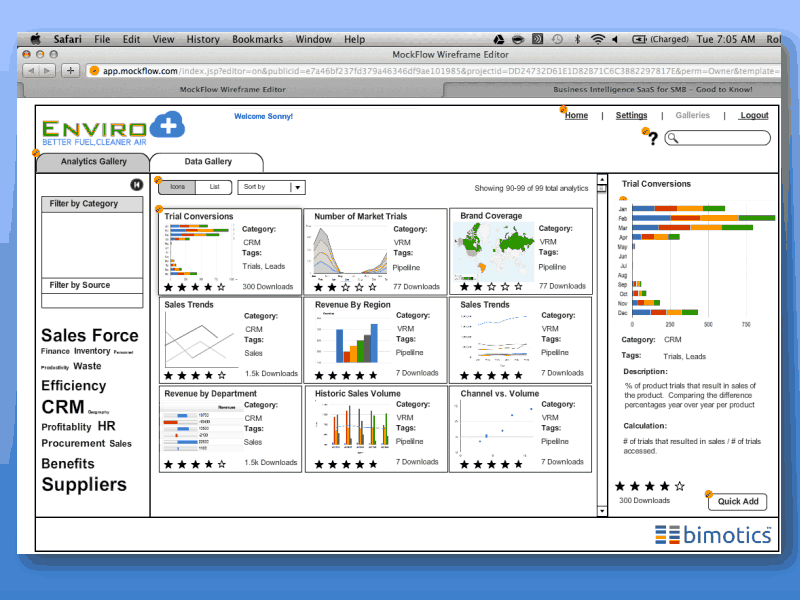
The value to business owners is that they do not need to know what metrics they want before they bring on analytics. Instead they pick and choose the available analytics that which makes sense to answer a particular business problem. They also can prioritize these analytics based on the business strategy they laid out for now.  If the business changes direction, then the business owner can change out the analytics to reflect this new vision. Not having to go back to the drawing board saves precious time. This gallery approach to analytics puts the definition and the prioritization of metrics and at the end as well as provides breadth and flexibility to a manager.  

Can this same principle be applied to solve an enterprise problem? Although very complex to build, can an “analytics mart” based on only the standard fields and best practice processes of major enterprise applications such as SAP, Oracle, Microsoft and SalesForce be built using the similar principles as our “gallery of analytics”? This “analytics mart” would cut across the different vendors so that advanced metrics are available. For example, metrics, like support center effectiveness, are shown as a blend of financials in SAP with support data from Siebel. This proposed approach, solves amongst the greatest barriers that keep enterprises from successfully implementing business intelligence in that it defines what to measure up front and avoids the interdepartmental politics in its allegiance to only standard and best practice processes.

Why companies have not implemented “analytics marts” already? The answer is twofold.  First building an analytic mart across enterprise systems houses many technical complexities especially when looking at all the software versions and system customizations that exist per enterprise. This is not to say that a solution is technically impossible however.  Second, budgets split by division and departments need to be continuously spent in full which enable data silo behavior over cross department collaboration and process analysis. In other words, large organizations have budgetary policies that encourages managers buy solutions while wearing horse blinders.  I wonder how much of a fundamental shift would need to occur in an organization to embrace data and metrics sharing.

The key to customer adoption of the “analytics mart” solution rests on a consolidated drive to improve the overall business and the willingness of  enterprise managers collaborate holistically. Will these managers be courageous enough to be measured against fundamental business process standards in addition to how well their divisions support the corporate strategy at hand?   

Monday, August 5, 2013

Our marketing campaign: Essential Analytics

Today, I just finished updating our first white paper for Bimotics’ Essential Analytics campaign. From concept to fruition, this milestone took much more time and effort than I expected- nearly a year. Much time was spent understanding what my potential customers, the small and medium sized business really need to know about analytics.  

After wading through topics about why metrics do not work for small business such as not having the know-how to set up metrics let alone time to look at metrics and having low data quality with the applications.  (Problems our software also solves but makes us sound like IT folks.)  I was wanted to focus on bringing value to those that were already open to metrics and analytics, but needed more practical advice on how to apply it. The response from potential customers that stood out and fit with my goal was: There is not enough context on when it is appropriate to use one metric or KPI.

As a practicing business analyst, gaining insight from the data and measurements comes more naturally.  But observation has shown that many small and medium sized businesses do not have a seasoned business analyst to “read the tea leaves”. Even our early adopters, can struggle with making sense of the numbers. Once an organization has the ability to measure their business operations and performance. Questions immediately arise:
  • Does this metric make sense for my business model?
  • Does this metric make sense for my industry?
  • Which of these metrics are more important?
  • What does the analytics even mean to my business?
  • Do these metrics even align with my current strategy?

From this research, I worked on the design for my for essential analytics marketing campaign. The white paper series will showcase one key business metric that one can get out of our first data sources: Quickbooks and Freshbooks. Then, we use business cases to describe how other managers and business owners use the metric to get solutions to everyday business problems. Our readers can get both more context around metrics and how they can be used, as well as, come up with ideas on how to use analysis to answer their own questions.

Tuesday, July 30, 2013

A design thinking approach: Observe extreme users 2

Continuing the learning from the Design Thinking training, figuring out who will be the extreme users of Bimotics is similar to the hypothesis of our early adopter customers. It is not a stretch to assume that those that are currently measuring and analyzing business would be the the most likely early adopter and positive extreme user.  On the other side of the spectrum, the extreme users that are least likely to use our products are those with either low data quality as poor quality adversely affects the effectiveness of analytics or hidden agendas that is not supported by the data.


The things I would like to observe from our extreme users that love our product and find value in our features include the categories of analytics that mean most to them.  Are they leveraging topics related to sales and marketing over supply chain and finance?  How are they using the customer flows we designed? To navigate to and from analytics and dashboards, are they taking necessary steps to get around? I have learned from other software entrepreneurs that small business “use copy” and paste more often than using “new” in order to avoid typing in the same information over and over. Finally, I would like to know on what devices they access our application. Our product is mobile enabled; and we have taken care to so that our infrastructure supports mobile.  I would like to know if it was worth it.


Something to observe related to the extreme users who don’t use or even dislike our product, it whether or not they go to their teams and applications and work to improve data quality.  Are there initiatives or trainings that makes their resources input better information?  For those whose agendas don’t have data to support their decisions, I would be very interested in seeing and understanding how communication is done to other team members and whether they get push back from the others with access to the same analytics.  

I’m sure there are other groups of extreme users.  And the identification of extreme users can extend past product users.  For example, those that read this blog would be not segmented by product customer.

Friday, July 26, 2013

A design thinking approach: Observe extreme users 1


I was excited for the training I attended this week called Design Thinking.  The trainer, Experience Point, based the whole session on the methodology of IDEO, one of the greatest design firms that have come up with innovative solutions that we use everyday.


A bunch of blogs and startup readings, have been about getting out of the building and talking to customers.  At Bimotics, we have constantly talked with small business owners of all types about our business idea, our tagline, our data sources we want to connect.  Sometimes we got an excited response and sometimes the person simply didn’t get it.  Getting to talk to anyone that will hear us out was always appreciated, but I can’t say the talks were always helpful. There was continued ambiguity on how to put what a business owner was saying in a context that made sense.

In the design thinking training, I learned the concept of observing the extreme users.  Extreme users are those that fall outside of the normal 80% if you are looking at a normal distribution. The extreme user is on both sides of the 80%. The first group represents the users that love and have completely adopted and live the subject you are studying. The other group represents the users that never use or care about the subject.  

Observing these groups is the key to getting real insight. You can see the difference between each extreme user. This can help provide context needed to get more quality insight. Being able to observe the right group requires a bit of profiling and a clear understanding of what you want to learn. Observing is not just having conversations with random users.  It is almost opposite, it is about consciously being objective and simply trying to understand how the user ticks.  When you have a conversation you may instill bias unintentionally.  

Monday, July 22, 2013

Deciding to keep our product beta private

This past weekend we decided that our first beta is going to be private.  This led me to really look into the difference between a public beta and a private beta.  What are the pros and cons of each.  In the past, many web apps declared a “private beta” because they were still buggy or not built to scale.  But although we have worked hard to address bugs and put in place structures to continuously deploy for scale, as a B2B we were concerned that opening our first product to the public and critics would inhibit our ability to finish the product per the vision.

We at Bimotics didn’t call our first sellable product an alpha either.  Through favorable circumstances we have a customer who is willing to pay to use our software.  It really didn’t seem right to have a selling alpha product, so private beta made more sense.  What sets this private beta apart from conventional thinking also is that our beta is not just missing certain features on our product roadmap.  Rather, there is still more to build before it is truly a subscription based analytics service for small business.

Other considerations taken in the decision to launch the private beta include the amount of customer support we could provide while continuing to develop our project, and more obviously, being able to preserve and defend the intellectual property awhile bit longer.  As the small business is our target market, we have know that providing a strong level of support will be key to making sure our customers continue to use the software but getting the positive word of mouth out to others.

Friday, June 28, 2013

Refining the Value Proposition

I’m trying the to create my first landing page using Lander ; and I am learning that the hard part is coming up with the content.  It makes sense that the value propositions are what you want to convey in the landing page, however, there also needs to be an element of what the customer would actually be looking for to get them to click in the first place.  

Going to my previous blog regarding the value propositions:
  1. Provide additional visualized insight on-line with data pulled directly from the cloud (no need to load files)
  2. Use a drag and drop metrics builder, to analyze your Quickbooks data-  don’t need to know how to run a query
  3. Push button web technology that doesn’t require IT resources


Now that I’m thinking why an SMB that want more analytics for Quickbooks, I don’t like these value propositions as much.  These are good points for the poor analyst that has to put together the reports, but the real value from Bimotics comes from being able to gain more insight from the financial data they already have.  The three value propositions together can be summed up as a seamless solution.  

Maybe the real value proposition for SMBs that use Quickbooks and want more analytics, is that Bimotics enables additional insight and analysis capability of their Quickbooks data in a seamless service.

What do you think? Would the small business be searching on what they want or how to build what they need? I suppose I can A/B test that.

Thursday, June 27, 2013

Looking for Landing Pages Providers

In order to carry out my early adopter experiment, I’m going to need to create landing pages on the cheap; and something I can set up myself.  I would like to build something that would capture at least e-mail addresses.  But I need something that looks professional and appeals to small business.  Looking around here are some landing page managers I have come across:


Unbounce appears to have fresh and modern looking page templates.  They emphasize conversions which from a marketing perspective is key.   I also think it is great that they have a reasonable subscription especially for new businesses and entrepreneurs.


Lander emphasizes getting set up in minutes.  Given the number of experiments I want to run, this is definitely a plus. The subscription price prices on the low end are amazing and perfect testing.  At the end of the day, I have not figured out which messages will resonate with my customers.  From what I can see, Lander doesn’t necessarily use templates, but claims to have a easy to use editor.  I will need to try their free trial to confirm how easy it is to use.


Hubspot has always been top of mind for a solution for lead generation. They seem to have the end to end solution for marketing automation, which I need when Bimotics is more mature.  But for purposes of my Coneierge MVP, I’m afraid that even $200 a month is too much.


Rocketstart must be a startup like Bimotics because they are about to launch their public beta.  They look promising, but unfortunately the timing is just not there.

Wednesday, June 26, 2013

Building my first Concierge MVP

Now that I have a healthy list of early adopter hypotheses, it is time to setup the Concierge MVP experiments.  If I understand it correctly for each hypothesized early adopter, I need to ask 3 main questions:
  1. What is your initial value proposition for your customers?
  2. How do you plan to convey the value proposition to them?
  3. What are you looking to measure?
(from “Will it Launch” by  Poormima Vijayashanker)


Trying this for the the hypothesis, “SMBs that use Quickbooks but would like more analytical and reporting capability.”
  1. What are your value propositions?
    1. Provide additional visualized insight on-line with data pulled directly from the cloud (no need to load files)
    2. Use a drag and drop metrics builder, to analyze your Quickbooks data-  don’t need to know how to run a query
    3. Push button web technology that doesn’t require IT resources


I wonder if there is a way to figure out which value proposition is most important.  


  1. How to convey the message?
    1. Do a mini adword campaign to see if people click on add-on reporting for Quickbooks 
    2. Create a video that demonstrates how we pull data on the cloud so you don’t have to sit there and load flat files
    3. Create a video that shows how you create a simple query through the drag and drop metrics builder
    4. Go to the next small business expo and ask people to fill out a small survey

  2. What will you measure?
    1. Use interaction in terms of adword results.  Additionally count e-mail addresses collected from the landing pages
    2. Count video views in youtube.  I would also count e-mail addresses collected from landing pages with the videos on them
    3. Process the survey results from the small business expo

One down six more experiments to think through. The survey is probably the easiest one to tackle. But it is time to learn landing pages too. Hopefully I will be able to reuse some of the content or landing pages for the others.  What are the easiest landing pages out there?

Tuesday, June 25, 2013

Hypotheses for Early Adopters

Yesterday I attended an event hosted by the new business incubator at Broward College.  Poormima Vijayashanker lectured on many lean startup concepts in her presentation “Will it launch?”. At Bimotics, we often pitched our startup as the “mint.com for small and medium sized-business”.  So I have to admit; I was a bit star struck to meet the founding engineer of the business we’ve strived to be like.  Turns out she is pretty cool and down to earth.  I’m going to ask join her Femigineer mentor group.


So the main takeaway I got  from the workshop was related to coming up with the right hypothesis for customer adoption- particularly for early adopters.  Bimotics is a cloud analytics company targeting small and medium-sized business, so here are the segments I hypothesize will be our early adopters. They are:


  1. SMBs that were established in the last 5 years that already use other cloud based applications, like SalesForce and Quickbooks to run their business
  2. SMBs that use Quickbooks but would like more analytical and reporting capability
  3. Consulting companies with analysts and data scientists that need a software platform to deliver their results to their clients
  4. SMBs with more than 3 resources running their operations (non-technical)
  5. SMBs comfortable using online marketplaces and app stores to source applications for run their business
  6. SMBs whose employees have begun to use mobile technology day-to-day, whether its a smartphone or a tablet
  7. SMBs that use social media as a source for business news.

With these hunches, the next step is to confirm or deny that these are my customers in the most cost efficient way.  Since we are only in alfa, I cannot just prove usage of by these groups, I will need to try out the concept of “concierage MVP” also taught at the workshop.